


Why 2026 Is the Year It Stops Being Optional
A blueprint for responsible AI adoption in clinical settings
What Is AI Governance, Really?
AI governance is the set of policies, frameworks, processes, and standards that ensure AI systems are developed and deployed responsibly, safely, and ethically across their entire lifecycle — from design through retirement.
It’s easy to dismiss this as a compliance checkbox, but it does real operational work:
- Consistency — it brings ethics, policies, roles, and tools into one coherent system, so five hospital branches running the same diagnostic AI follow one protocol instead of five interpretations.
- Scalability — a governance structure built for one system (say, scheduling AI) can extend to the next deployment (clinical decision support) without a rebuild from scratch.
- Risk management — it systematically identifies and mitigates AI-related risks before they cause harm, such as catching a model trained on urban data that underperforms for rural patients before it ever reaches deployment.
- Compliance — it creates the documentation trail regulators expect, catching gaps like a cloud AI vendor that never signed a Business Associate Agreement before patient data is shared.
The Five Pillars Every Framework Shares
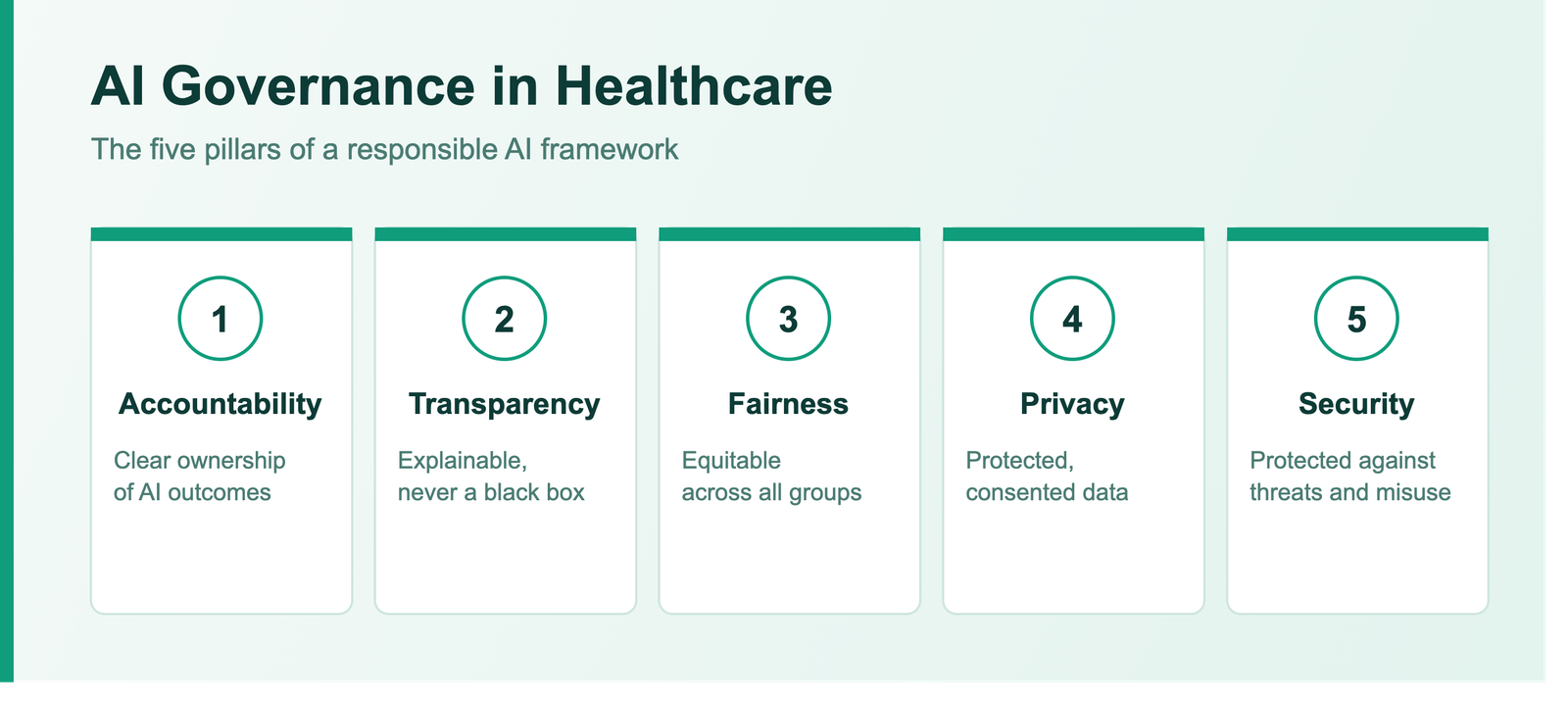
Whether you look at NIST’s AI Risk Management Framework, the OECD principles, the EU AI Act, or the UK’s pro-innovation approach, the same five pillars show up again and again:
- Accountability — clear ownership of AI outcomes, so someone is always responsible when an AI system causes harm or makes an error.
- Transparency — AI decisions need to be explainable and visible to stakeholders, never a black box.
- Fairness — AI should treat all groups equitably, with biases in training data actively identified and corrected.
- Privacy — data used to train or run AI must be protected, properly consented to, and used only for its intended purpose.
- Security — AI systems need protection against threats, adversarial attacks, and misuse.
The Global Regulatory Landscape
Several frameworks now shape how organizations operationalize these pillars:
- NIST AI RMF (United States) — the most widely used enterprise reference, structured around four functions (Govern, Map, Measure, Manage) and seven trustworthy AI traits. It’s voluntary, but frequently used alongside EU AI Act compliance work.
- EU AI Act (European Union) — the world’s first comprehensive AI law, classifying systems from unacceptable to minimal risk. Its high-risk provisions for medical AI take effect August 1, 2026, bringing mandatory conformity assessments, logging, human oversight, and transparency requirements.
- ISO/IEC 42001 (Global) — the first globally certifiable AI management standard, covering ethics, accountability, transparency, and data privacy, with third-party audit certification available.
- UK AI Framework (United Kingdom) — a pro-innovation, sector-regulator-led approach built on five principles: fairness, transparency, accountability, safety, and contestability.
The Six Building Blocks of a Governance Framework
A working governance framework isn’t a single policy document — it’s six interlocking components, and removing any one of them creates a gap:
- Principles & Ethics — the normative core: fairness, transparency, accountability, privacy, security, and human oversight.
- Roles & Responsibilities — an AI Governance Council, Ethics Board, data scientists, business owners, legal and compliance, and data stewards.
- Policies & Standards — data privacy policies, model fairness standards, security protocols, and disclosure requirements spanning the full AI lifecycle.
- Processes & Procedures — model lifecycle management, risk assessment, bias mitigation, change management, and incident response.
- Tools & Technologies — model monitoring, bias detection software, data lineage trackers, and compliance reporting dashboards.
- Training & Communication — educating every stakeholder on the framework and policies, with clear channels for feedback and incident reporting.
Why Healthcare Is a Special Case
Healthcare is classified as high-risk under NIST, the EU AI Act, and most global frameworks — for good reason. The opportunity is enormous: AI is already reading radiology and pathology scans, powering real-time clinical decision support for drug interactions and sepsis risk, accelerating drug discovery, automating prior authorizations and billing, enabling remote patient monitoring, and flagging high-risk patients for readmission or deterioration. The global healthcare AI market is projected to reach $45 billion by 2026.
But the risk profile is just as significant:
- Patient safety risk — every AI failure mode in healthcare is a clinical risk event. A misclassified scan or an incorrect medication recommendation directly harms patients.
- Algorithmic bias — models trained on skewed data often perform worse for minorities, women, and elderly patients. HHS OCR Anti-Bias rules now prohibit discriminatory AI in federally funded healthcare.
- Data privacy and HIPAA — using protected health information to train AI without consent is a HIPAA violation, anonymized records can sometimes be re-identified, and many third-party AI vendors don’t meet Business Associate Agreement requirements — a compliance gap many organizations don’t realize they have.
- Lack of transparency — clinicians need to understand why an AI system made a recommendation before they can trust and act on it. Black-box AI creates real legal liability when decisions are contested.
- The implementation gap — only 23% of health systems have formal governance in place, even though 78% plan clinical AI deployment within two years.
- Cybersecurity vulnerabilities — AI expands the attack surface, and healthcare is already the most targeted industry for cyberattacks. Adversarial inputs can manipulate model outputs, so AI security needs to meet clinical-grade standards.
The Regulatory Clock Is Ticking
Several healthcare-specific requirements are landing in quick succession through 2026:
Regulation | Region | Effective |
HIPAA | US | Ongoing |
HHS OCR Anti-Bias Rule | US | Active 2025 |
Texas HB 149 (AI disclosure to patients) | US (Texas) | Jan 1, 2026 |
Colorado AI Act | US (Colorado) | Jun 2026 |
EU AI Act — Medical provisions | EU | Aug 1, 2026 |
Joint Commission / CHAI certification | US (voluntary) | 2026 rollout |
Texas HB 149 requires providers to explicitly disclose when AI tools are involved in a patient’s care. Colorado’s AI Act adds governance and disclosure requirements, including documented risk assessments for high-risk systems. The EU AI Act’s medical provisions bring mandatory conformity assessments and CE marking for medical-grade AI. And a voluntary certification program from the Joint Commission and the Coalition for Health AI (CHAI) is rolling out this year to give organizations a structured path to demonstrate governance maturity.
Best Practices for Healthcare AI Governance
Organizations that are ahead of this curve tend to follow a consistent set of practices:
- Establish a cross-functional AI Governance Committee with clinical leads, legal/compliance, IT/data science, ethics, and operations represented — this group sets strategy, reviews incidents, and approves new AI deployments.
- Conduct formal risk assessments for every clinical AI tool before deployment, covering patient safety, bias, privacy, and security.
- Require algorithmic transparency — clinicians should be able to understand and explain AI-driven recommendations, and black-box models shouldn’t be used for high-stakes clinical decisions.
- Build patient disclosure workflows that align with laws like Texas HB 149, so patients know when AI is involved in their diagnosis, treatment, or prior authorization.
- Monitor AI after deployment for accuracy drift, emerging bias, and safety signals, and re-validate systems after major updates.
- Pursue CHAI/Joint Commission certification to align with the emerging voluntary standard and structure governance documentation.
- Train clinical and administrative staff on AI limitations, escalation paths, and their responsibility to question AI outputs.
- Integrate AI risk into Enterprise Risk Management — this belongs at the board level, not buried inside IT.
A Practical Roadmap
Building a governance framework from zero doesn’t have to be overwhelming. A workable sequence looks like this:
- Secure executive sponsorship — get board-level commitment and define scope: which AI systems and business units are covered.
- Form the AI governance body — assemble a cross-functional council spanning legal, clinical, IT, risk, ethics, and operations.
- Define principles and policies — establish ethical guidelines and create policies covering data, models, deployment, and monitoring.
- Map AI lifecycle processes — design processes for risk assessment, bias mitigation, validation, and incident response.
- Deploy tools and technology — implement model monitoring, bias detection, data lineage tracking, and automated compliance reporting.
- Train staff and communicate — train all stakeholders and establish clear feedback and incident-reporting channels.
- Monitor, review, and iterate — define governance KPIs, report regularly to leadership, and run an annual framework review cycle.
The Bottom Line
AI governance in healthcare isn’t an IT compliance checkbox — it’s a board-level strategic imperative that determines whether AI adoption is trustworthy and scalable, or a liability waiting to surface. Patient safety, HIPAA, algorithmic bias, and a wave of new state and federal regulations make healthcare one of the most complex AI governance environments of any industry.
The math is stark: 23% of health systems have formal governance today, while 78% are moving ahead with clinical AI deployment regardless. Closing that gap — starting with a cross-functional governance committee — is the most urgent healthcare AI priority of 2026. With Texas HB 149, the Colorado AI Act, and the EU AI Act’s medical provisions all taking effect this year, compliance is no longer something organizations can defer.
Sources: NIST AI Risk Management Framework (AI RMF 1.0); EU AI Act — Official Text, August 2026 Provisions; ISO/IEC 42001 AI Management Systems Standard; Healthcare Brew — State of Healthcare AI Regulation; Joint Commission / CHAI — AI Certification Program 2026; HHS OCR Anti-Bias Regulations for Healthcare AI; Texas HB 149 & Colorado AI Act — 2026 State Legislation; McKinsey Healthcare AI Survey 2025.